The Node.js Event Loop Explained .
Internal Working how code executes.

What the event loop is .
The event loop is what makes Node.js so fast and delivers results quickly. So, let's understand what an event loop is.
- The event loop is a mechanism that provides a feature for handling asynchronous tasks efficiently. For now, think of asynchronous tasks as heavy tasks. It runs them in the background so they don't block the main execution thread.
Before delving deeper into the event loop, let's understand what synchronous and asynchronous tasks are.
Synchronous tasks are tasks that execute line-by-line. The next function or code won't execute until the current task is complete.
In asynchronous tasks, heavy operations like file uploads are handled asynchronously so that if the upload takes time, the entire server doesn't get stuck on that operation. Instead, it processes in the background, allowing the rest of the application to continue running smoothly.
Now, what the event loop does is execute synchronous tasks first, then asynchronous tasks. It's not that all asynchronous tasks are executed last.
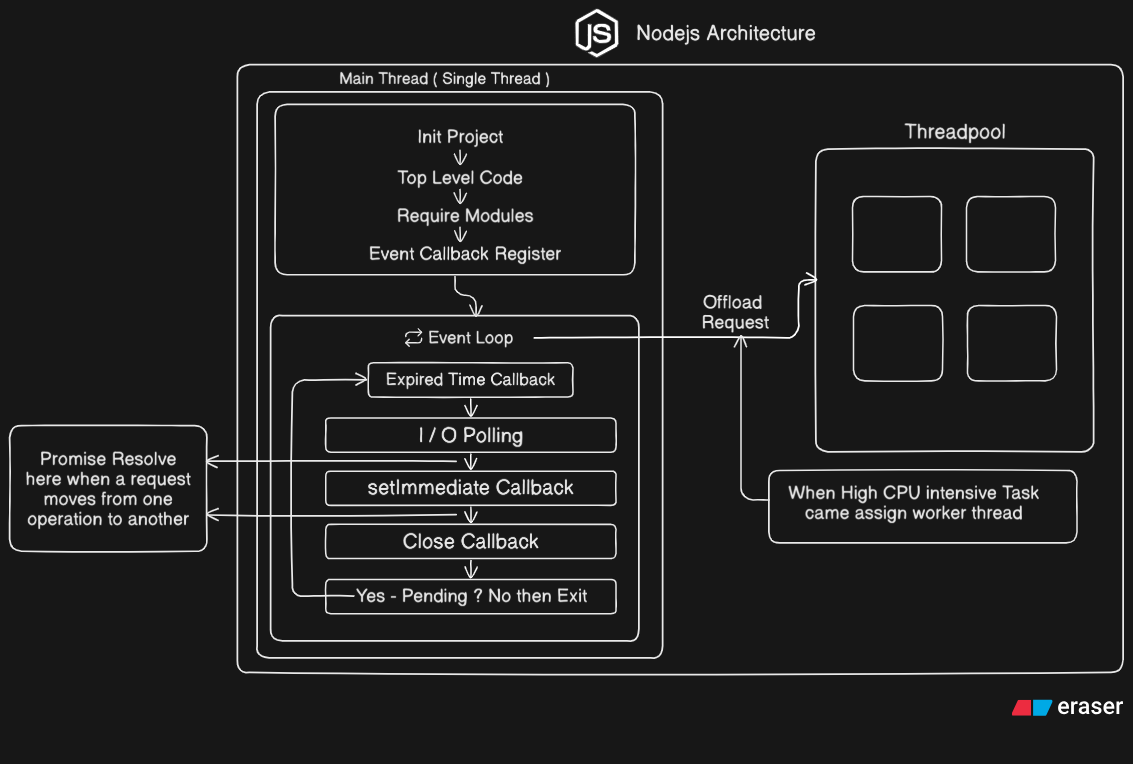
Basically, whatever code you write goes into the event loop. It filters the code based on how it's written. Synchronous code is executed line byline, and all asynchronous code is assigned to threads running in the background.
Whenever those background tasks finish their work, they return to the event loop, and the event loop outputs their results.
For a clearer understanding, here's a diagram below.
Why Node.js needs an event loop .
Node.js runs on a single thread. Above we discuss about event loop know you have idea what it is, now let's talk about why node.js need event loop.
- Now the problem is this, if heavy tasks like file uploads, database queries, API calls, or timers start running directly on the main thread, then the whole application can get blocked until that task finishes, other user request would have to wait, and the application would becomes slow, now assume have more than 100+ users.
So this problem is solved using the event loop.
The event loop helps Node.js handle asynchronous tasks in the background without blocking the main execution thread. It manages tasks properly so the application can continue running smoothly while heavy operations are being processed.
When an asynchronous task completes, the event loop brings its result back and executes the related callback or code.
Because of this mechanism, Node.js can handle multiple requests efficiently even though it works on a single thread.
This is the reason why node.js need the event loop.
Task queue vs call stack (conceptual only) .
The call stack is responsible for executing synchronous code. Whenever a function is called, it gets added to the call stack, and once the function finishes execution, it gets removed from the stack.
On the other hand, the task queue is used for asynchronous tasks. Whenever asynchronous operations like timers, API calls, or file handling complete, their callbacks are placed inside the task queue.
The event loop continuously checks both the call stack and the task queue. If the call stack becomes empty, then the event loop takes tasks from the queue and pushes them into the call stack for execution.
How async operations are handled .
Asynchronous operations are mostly heavy tasks that can take time to complete, like file uploads, database queries, API calls, or timers.
Now if these tasks run directly on the main execution thread, then the whole application can get blocked until the task finishes.
So what happens is that whenever Node.js sees asynchronous code, it does not execute that task directly on the main thread. Instead, it sends that operation to the background to be processed separately.
Meanwhile, the main thread continues executing the remaining synchronous code without waiting for the asynchronous task to finish.
Once the background task completes its work, its callback or result gets placed inside the task queue.
After that, the event loop checks whether the call stack is empty or not. If the call stack becomes empty, then the event loop moves the completed task from the task queue to the call stack for execution.
Timers vs I/O callbacks (high level).
Both are asynchronous operations handled by Node.js with the help of the event loop.
Timers are operations that execute after a specific amount of time. Functions like
setTimeout()andsetInterval()come under timers.For example, if we write a timer for 5 seconds, then Node.js sends that task to the background and continues executing the remaining code. Once the given time completes, the callback function becomes ready for execution.
On the other hand, I/O callbacks are related to input and output operations like:-
file handling,
database queries,
network requests,
or API operations.
Once the I/O operation completes, its callback becomes ready for execution.
The event loop manages both timers and I/O callbacks and sends them to the call stack whenever execution is possible.
Role of event loop in scalability .
Scalability means the ability of an application to handle more users, requests, or operations efficiently without slowing down. Now Node.js is able to handle many requests efficiently because of the event loop.
- The event loop helps Node.js manage asynchronous tasks without blocking the main execution thread. Heavy operations like file uploads, database queries, API calls, and network requests are processed in the background while the main thread continues handling other requests.


